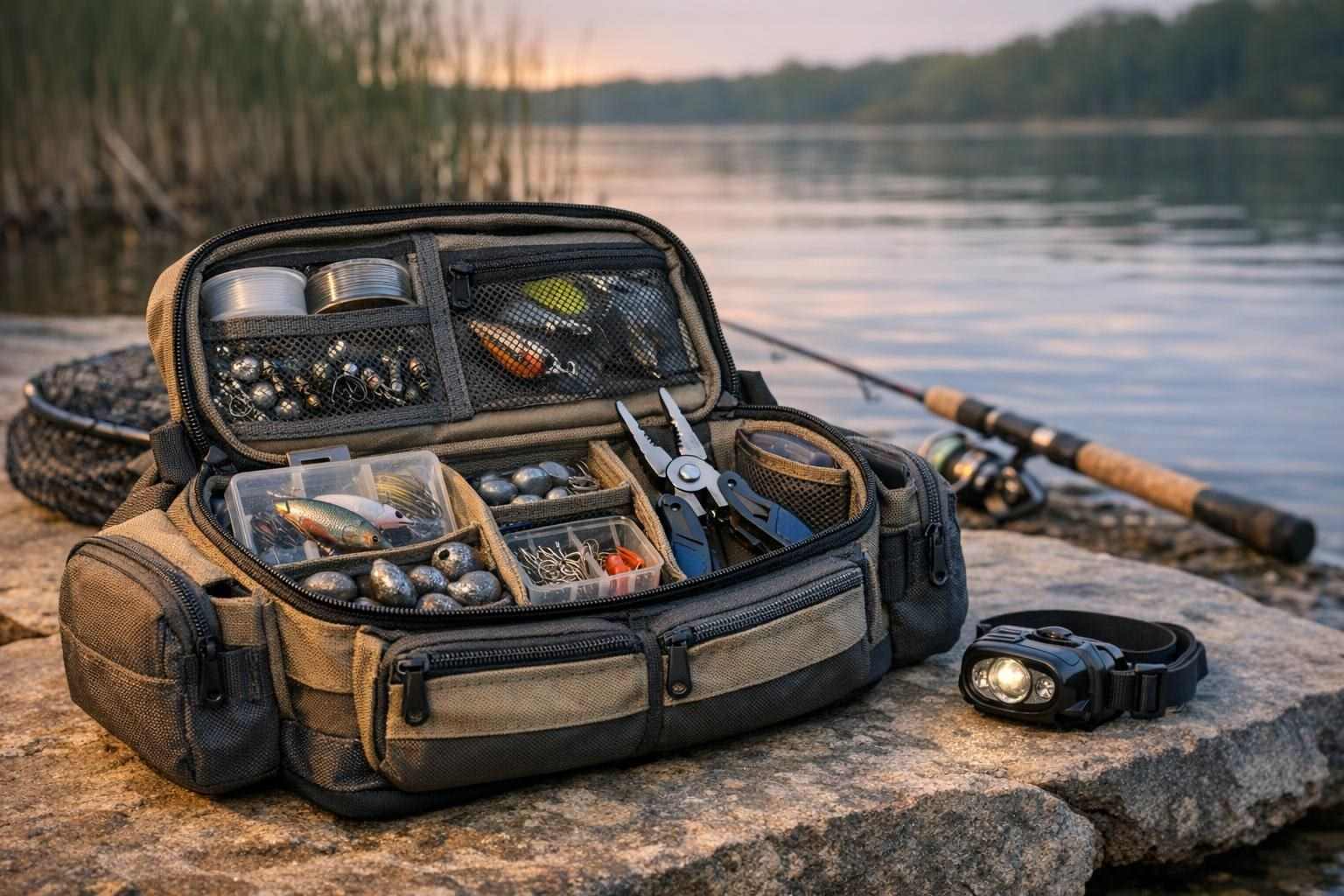
The most common mistakes on short fishing trips are caused by the smallest of oversights: the missing leader, tangled up hooks, dead light source (headlamp or other) and above all the landing net buried under a stack of clothing. Keeping the useful stuff in ordered storage helps keep it visible and limits the amount of items one needs to take to the shore in order to fish there. The goal of practical storage is not to own more gear for outdoor fishing but to make the gear one already owns more usable.
Start with a repeatable shore-fishing kit
First organize a repeatable shore-fishing kit. Repeatable means you can lift the container with one hand. You can choose a small tackle box, a soft-sided pouch or a small to medium sized backpack. Try to organize the kit in separate areas for terminal tackle, tools and personal items. Try to keep frequently used items in the easiest-to-reach areas. reserve deeper pockets for the backups.
A very useful basic outfit would be a few reliable lures and/or baits, a spare length of line, a few hooks, some weights, swivels and pliers, a pair of scissors or even better a line cutter, and maybe a measuring stick. First aid kit, hand cleaner, and a headlamp will also come in handy on the return journey to the car. The local conditions and species you are after will influence what you carry in your shore fishing outfit.
Leave your frequently used pieces in the easiest-to-reach area of your tackle case and store your spares in the depths of the case.
Sort tackle by task, not by shape
Even organized tackle can be disorganized when unpacked and spread out on a table or floor. So, it's best to sort out your tackle by the task at hand. In other words, for the lures that have been used for catching fish, it's best to sort them out into the hooks section, the swivels section, and the weights section, each clearly labeled so that you can find what you're looking for in short order, even in poor light.
It's also important to avoid over packing your fishing kit with too many small containers. At first this seems like a good idea, but before you know it you will have lost half the lids, and be spending far too much time sorting through each piece of tackle. Use the smallest container possible for each type of terminal tackle and label it with the obvious – 'hooks', 'weights', 'leaders' etc.
Soft plastics, bait containers, etc. should be stored in separate areas of the gear. Wet items should be stored apart from dry items such as line and tackle, as well as clothing. A sealed pouch containing wet items can contain smells and even dry out and become stiff as well as developing residue on items within the pouch. Such pouches should be opened as soon as you return from your fishing and washed out and then left to dry.
Make the evening load easy to check
Use a short pre-departure check list for your evening fishing trip, listing out the few items you need to take in order to stop your fishing for the day. These would include your rod and reel, fishing line, terminal tackle, pliers, light, water and any other personal items and/or items for access that you may need.
Check your rod for any obvious signs of damage, check your line for signs of wear such as flailing, fading or becoming flattened in places, and ensure that all parts of your rod (including sections) are locked into place to prevent them from becoming detached while being carried. Fold or secure your net in a way that will stop it getting caught on other items in your tackle bag.
Lamps should be checked for proper function before dusk. Spare batteries for lights should be stored in a separate place to the used ones to avoid confusion and to ensure that new ones are obtained in good time for the next trip. The phone should not be used as the sole light source as it will be required for communications and mapping etc and its battery may be affected by cold and by being used heavily.
Protect the gear between trips
Ensure tackle storage is able to be opened for drying of lines, lures, tools and clothing. Rince any items that have got residue on them and allow to dry. Check for corrosion on any metal components before storing.
Don't leave loose hooks in your pockets or in the bottom of your bag. A hook can easily catch in fabric, in your skin or in another piece of tackle and be a major problem. Cap your lures, use lure covers or have separate tackle compartments for items such as hooks and lures. Store sharp items such as pliers, forceps, and scissors closed or sheathed.
One thing to remember is to store your main tackle in the one place that you know will be OK and keep a few items separately such as batteries, food, waders etc. Items such as these would deteriorate rapidly in a closed bag for days and would need to be checked on a regular basis.
Carry only what the shoreline allows
This setup is particularly suited for uneven terrain, with sharp rocks or very narrow paths. As with anything you plan to carry any distance, the first consideration is how far you will be carrying it from your vehicle. Short distance = shoulder bag. Longer distance = backpack. It distributes weight much better than a shoulder bag, but does make it slightly harder to grab things from your tackle bag.
Store your phone, keys, license and other essentials that could get damaged in the water in a dry bag or even better in a waterproof pouch. The waterproof storage does not replace good care, so be sure to close all zippers and do not put the pouch in a place where it could fall into the water when you lay down the rest of your tackle.
Before you head off to the shore consider how you are going to get there with all your tackle. Remember to take all your waste with you including old line and plastic containers, also be aware of local access restrictions, fishing regulations including season, and what type of bait you can use. Always check current fishing information before you head off for your trip.
Reset the kit before storing it
Empty your bag, clear out all the rubbish and wash and dry all your wet tackle. Make sure all your tools are back in their proper stores. Re-stock the items that you used from your backup supplies before they are needed for your next trip out.
Also consider where a container for often used tackle has to be placed to not get damaged when the rest of the bag is closed. Sometimes when reorganizing your tackle and fishing gear, you will find that you have to remove some items. For example, you might have to take out rarely used lures or take out rods for which you do not have matching tackle. The rods for which you do not have matching tackle can be stored separately.
For really high usage items, we would mark the outside of a bag with a name or color so that all of our outdoor items can be stored together in a shared location. The simplest handoff between your fishing trips and your home life is to: check, carry, fish, clean, and reset.